In the late 1990s through the early 2000s, due to continually rising home prices in the U.S., banks and homebuyers were over-eager to enter into mortgages where the house-prices were over-valued and the homebuyers were under-qualified for the loan amounts.
In 2008 came what was called the “Housing-Bubble Burst”, “Mortgage-Derivative Defaults”, “Banking Crisis” where millions of homebuyers were unable to make their mortgage payments, or were unwilling to make their mortgage payments due to the realization that their houses were worth much less money than what was still owed.
2008-2010 there were millions of home foreclosures, hundreds of bank failures, and the U.S. economy entered a recession. Due to a sudden halt in new home construction, and a recession in the economy, every state in the U.S. began to experience high unemployment beginning in 2008.
When all U.S. media, including television, radio, newspapers, magazines, and internet social media began to publicize that “everyone coming to North Dakota was making $100K per year working in the oil field”, this caused about 10,000 people per month to begin arriving in North Dakota during the 2007-2014 Oil Boom.
The towns of Williston, Watford City, and Dickinson soon had occupancy rates of over 100% as every house, apartment, hotel, motel, trailer park, campground, was fully rented and people were forced to sleep in their cars. Home prices and housing rents doubled, tripled, and quadrupled in Williston, Watford City, and Dickinson.
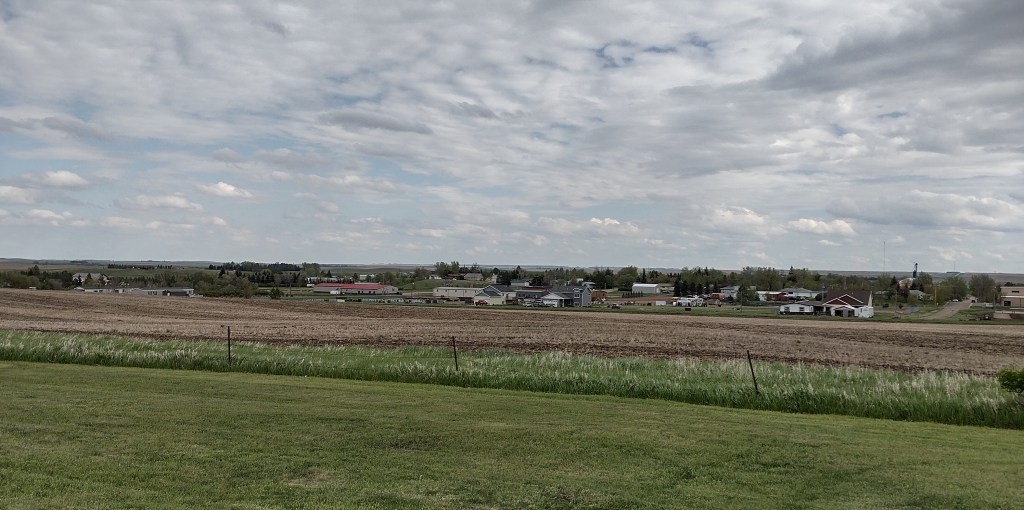
Because New England is twenty-five miles south of Dickinson, and below the southern region of the busiest oil field activity, home prices and housing rental prices were lower in New England compared to Williston, Watford City, and Dickinson. New apartment developments, new trailer parks, and man-camps were not constructed in New England during the Oil Boom, unlike Williston, Watford City, and Dickinson.
The people who came to North Dakota during the 2007-2014 Oil Boom who were looking for work in the oil field, usually sought to find housing somewhere near Williston, Watford City, or Dickinson. A few of these people who desired or needed an actual house, but could not afford tripled or quadrupled house prices, had to look outside of the busiest oil field region, in towns such as New England, Richardton, Taylor, or Gladstone.
During the North Dakota Oil Boom, many new jobs were created as a result of oil field activity, but these jobs weren’t in the oil field. Examples of these jobs were nurses, school teachers, retail workers, carpenters, mechanics, plumbers, electricians, truck drivers, delivery drivers, police officers, paramedics. These new jobs paid well, but not as high as the people in the oil field were paid. For people who didn’t have to actually drive into the Watford City or Williston area to work, who were not paid extremely high wages, towns such as New England, Richardton, Taylor, Gladstone were less expensive, and it was possible to buy or rent an actual house, instead of a quadrupled-priced apartment.
The people who relocated from out of state to New England during the 2007-2014 Oil Boom were not all drill-rig-hands, work-over-rig hands, frac-operators, wire-line operators, pumpers, oil-haulers, and water-haulers, that had to travel into the Watford City or Williston oil field areas every day, but were mostly people who had construction or trades jobs.
When the Oil Boom ended in 2015 because the price of oil dropped to $80/barrel and lower, some of the new residents from out of state who had moved to New England lost their jobs, but many did not because they worked in construction and trades, and still had work for several more years.
However, beginning in 2019, there did begin to be some home foreclosures in New England where the out of state workers just packed up and left, because they couldn’t find work anymore.

 New England North Dakota.com
Leave a comment